Wholesale Silver Jewellery
Why You Should Buy Complete Silver Jewellery Range from One Trusted Manufacturer
 Oct 16, 2026
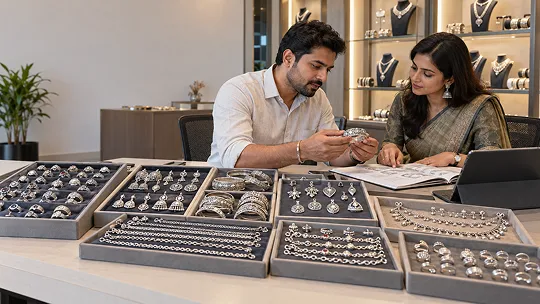
For a jewellery business, buying silver jewellery is rarely just about finding attractive designs. A wholesaler or retailer may need rings, earrings, bangles, chains, payal, bichiya, bracelets and other categories at the same time. When every category is sourced from a different supplier, managing the range can become surprisingly complicated.
This is where a one-stop silver jewellery manufacturer can offer a practical advantage. Instead of coordinating with multiple suppliers for different product categories, businesses can source a broader range from one reliable manufacturing partner. The benefit is not simply convenience, it can also affect purchasing, inventory planning, product consistency, communication and the ability to respond to customer demand.
But does buying everything from one manufacturer always make sense? Not necessarily. The real advantage depends on the manufacturer’s range, stock availability, production capabilities, pricing structure and ability to consistently meet B2B requirements.
So, what should wholesalers and retailers consider before choosing this sourcing approach?
What Does a One-Stop Silver Jewellery Manufacturer Mean?
A one-stop silver jewellery manufacturer is a supplier that offers multiple jewellery categories under one sourcing relationship.
Instead of purchasing different categories from separate vendors, a business may be able to source a wider assortment from the same manufacturer, depending on its available range.
For a jewellery business, this can include categories such as:
- Silver rings
- Earrings
- Silver kada and bangles
- Bracelets
- Chains and necklaces
- Silver payal and kada payal
- Bichiya
- Juda and kandora
- Baby kadli
- Pendants and other jewellery items
The important point is that one-stop sourcing is about range and sourcing efficiency, not simply buying a large quantity from one supplier.
A manufacturer may have an extensive catalogue, but businesses should still evaluate product quality, designs, weights, availability, pricing and order requirements before consolidating purchases.
Why Is Buying the Complete Range from One Manufacturer Useful?
The biggest advantage is simple: fewer sourcing relationships can make a jewellery business easier to manage.
When several product categories come from one trusted manufacturer, purchasing becomes more centralized. This can reduce the time spent communicating with multiple suppliers and make it easier to coordinate orders.
Here are some of the most important business advantages.
1. Easier Product Sourcing
Imagine a retailer needs new stock across six different jewellery categories. With multiple suppliers, the retailer may have to search catalogues separately, compare prices, discuss availability and coordinate individual orders.
A manufacturer with a broad product range can simplify this process.
The buyer can review different categories through one sourcing relationship and create a more complete order based on current business requirements.
This is particularly useful for wholesalers who regularly need variety rather than a single type of product.
2. Better Variety Under One Supplier
Customers rarely shop according to a single jewellery category.
A retailer may have demand for a lightweight ring from one customer, a pair of earrings from another and traditional payal from someone else. A wholesaler faces the same challenge at a larger scale because its own customers may have different preferences.
A broader supplier range makes it easier to build a balanced inventory.
Instead of thinking only about individual products, businesses can plan their assortment across categories:
| Category | Possible Business Role |
|---|---|
| Rings | Everyday and occasion-based demand |
| Earrings | Broad customer appeal and design variety |
| Bangles & Kada | Traditional and fashion-oriented collections |
| Payal | Strong category presence in many Indian markets |
| Bichiya | Traditional and everyday jewellery requirements |
| Chains & Necklaces | Higher-value assortment options |
| Bracelets | Contemporary and gifting-oriented selections |
| Baby Jewellery | Specialized customer segment |
The ideal mix will naturally differ according to location, customer base and selling channel.
3. Simplified Order Management
Multiple suppliers can mean multiple conversations, quotations, order confirmations, invoices, dispatch updates and follow-ups.
Working with one manufacturer for a larger portion of the range can reduce this administrative burden.
This does not mean that every order becomes automatically simple. Businesses still need to check product-wise quantities, weights, pricing, availability and delivery schedules. However, having fewer supplier relationships can make the overall purchasing process more organized.
For growing jewellery businesses, this becomes increasingly important because purchasing complexity tends to increase along with the product range.
4. More Consistent Manufacturing Standards
Consistency becomes particularly important when jewellery is being sold under the same business name.
When similar categories are sourced from different manufacturers, there can be differences in:
- Finishing
- Weight
- Sizing
- Design interpretation
- Product specifications
- Packaging practices
- Availability patterns
A single manufacturing relationship can make it easier for buyers to establish consistent expectations.
This is one reason manufacturer selection should go beyond comparing the lowest quoted price. A supplier’s ability to maintain dependable production and product standards can have a greater long-term impact on a jewellery business than a small difference in the initial purchase price.
5. Easier Inventory Planning
Inventory planning becomes more effective when a business understands its supplier’s product range and availability.
Suppose a wholesaler knows that certain categories move quickly while others sell more slowly. Instead of purchasing randomly, it can plan future orders around actual sales patterns.
A broad-range manufacturer can support this type of planning by allowing the buyer to review multiple categories when replenishing stock.
The objective should not be to purchase every category simply because it is available.
A better approach is to ask:
Which categories sell consistently? Which products need frequent replenishment? Which designs are seasonal? Which products should be tested in smaller quantities?
These questions help turn a large catalogue into a practical inventory strategy.
6. Potentially More Efficient Business Communication
Communication is an overlooked part of wholesale sourcing.
When a buyer works with many suppliers, every supplier may have different ways of handling:
- Product enquiries
- Minimum quantities
- Pricing
- Custom requirements
- Availability
- Dispatch
- Payment terms
- Order confirmation
With a trusted manufacturer relationship, buyers can become familiar with the supplier’s processes over time.
That familiarity can make repeat purchasing more efficient.
For example, an established buyer may already understand how products are listed, how weights are communicated and how stock enquiries are handled. This reduces unnecessary back-and-forth and allows both sides to focus on the actual order.
Why Manufacturer Selection Still Matters
The idea of buying a complete range from one supplier sounds attractive, but one-stop sourcing only works when the supplier itself is dependable.
A large catalogue alone does not make a manufacturer suitable for every business.
Before consolidating purchases, wholesalers and retailers should examine several factors.
Product Range
Does the manufacturer actually cover the categories your customers demand?
A broad range is useful only when it is relevant to your market.
Stock Availability
A catalogue may contain hundreds of designs, but buyers also need to understand what is readily available and what requires production.
For businesses working with fast-moving inventory, stock availability can be just as important as product variety.
Manufacturing Capability
Understanding whether a supplier is an actual manufacturer or primarily a reseller can help buyers evaluate production control and sourcing arrangements.
In-house manufacturing capabilities can be particularly relevant when businesses need consistency across repeated orders.
Pricing Transparency
Silver jewellery pricing can depend on factors such as product weight, quantity, silver rates and the specific design or manufacturing requirements.
Therefore, buyers should avoid comparing suppliers purely on one product’s quoted price.
A more useful comparison considers the overall purchasing value, including product range, availability, consistency and ordering convenience.
How One-Stop Sourcing Can Help Wholesalers
For wholesalers, range breadth can be especially valuable.
A wholesaler may supply retailers with different customer profiles and therefore needs a diverse assortment. Buying multiple categories from one manufacturer can make it easier to build mixed orders and replenish different product segments.
The key benefits can include:
- Broader assortment planning
- Simplified bulk purchasing
- Fewer supplier communications
- Easier replenishment
- Better understanding of product availability
- More organized inventory management
However, wholesalers should still analyse category-wise movement rather than assuming every product will perform equally well.
A large range is valuable when it matches actual market demand.
How Retailers Can Benefit
Retailers often face a different challenge: limited display space.
For them, the objective is not necessarily to buy the maximum number of products. It is to select the right products within the available space and budget.
A broad supplier can make this process easier because retailers can evaluate several categories while maintaining a relatively simple sourcing structure.
For example, a retailer may combine everyday rings and earrings with selected payal, bangles, chains and seasonal products. This creates category diversity without requiring a completely different sourcing relationship for every product type.
What Should You Ask Before Choosing a One-Stop Manufacturer?
Before moving a large portion of your purchasing to one manufacturer, ask practical questions such as:
- Which jewellery categories do you regularly manufacture and supply?
- How many designs or SKUs are currently available?
- Which products are available in ready stock?
- How is pricing calculated?
- What are the minimum order requirements, if any?
- How are product weights and specifications communicated?
- How consistent is availability for repeat orders?
- What is the expected delivery process?
- Can different jewellery categories be included in the same order?
- How does the manufacturer handle new designs and changing market demand?
These questions can reveal much more about a supplier than a simple price comparison.
When Is One-Stop Sourcing the Right Choice?
One-stop sourcing can be particularly useful when a business:
- Regularly purchases several jewellery categories
- Wants to simplify supplier management
- Needs a broad product assortment
- Values consistent manufacturing
- Frequently places repeat orders
- Wants to streamline inventory replenishment
- Is expanding its product range
It may be less suitable when a particular category requires highly specialized production that the primary manufacturer does not offer or when another supplier provides a significant product advantage.
The right strategy is therefore not "buy everything from one supplier at any cost."
It is:
"Build a strong sourcing relationship with a manufacturer that can reliably meet most of your important requirements."
A Smarter Way to Build Your Silver Jewellery Range
A complete jewellery range should be built around your customers, not simply around the size of a manufacturer’s catalogue.
Start by studying your sales history and identifying your strongest categories. Then divide products into fast-moving, regular, seasonal and experimental segments.
From there, evaluate manufacturers based on:
- Range
- Product relevance
- Availability
- Manufacturing consistency
- Pricing
- Order flexibility
- Delivery capability
- Long-term reliability
This approach helps businesses avoid overstocking while still maintaining enough variety to serve different customer requirements.
For a manufacturer such as Aditi Ornaments, the combination of a broad silver jewellery range, ready stock availability and pan-India delivery illustrates why one-stop sourcing can be particularly relevant to B2B buyers looking to simplify procurement while maintaining product variety.
Final Takeaway
Buying a complete silver jewellery range from one trusted manufacturer can make sourcing more efficient, but the real benefit goes beyond convenience. It can simplify communication, support inventory planning, provide broader category access and help businesses build a more consistent purchasing process.
For wholesalers and retailers, the goal should not be to find the supplier with the biggest catalogue alone. The better objective is to find a manufacturer whose product range, availability, manufacturing capabilities, pricing and service structure match the realities of your business.
When those factors align, one trusted manufacturing relationship can become an important part of a more organized and scalable silver jewellery sourcing strategy.
Conclusion
For a growing silver jewellery business, sourcing is not just a purchasing activity, it is part of inventory strategy and day-to-day operations. A dependable one-stop manufacturer can help reduce unnecessary complexity while giving wholesalers and retailers access to a broader product range.
The smartest approach is to combine convenience with careful supplier evaluation. When product variety, availability, manufacturing consistency and business requirements come together, one trusted manufacturer can become a valuable long-term sourcing partner.
Frequently Asked Questions (FAQ)
1. What is a one-stop silver jewellery manufacturer?
A one-stop silver jewellery manufacturer is a supplier that manufactures or supplies multiple silver jewellery categories, allowing wholesalers and retailers to source a broader product range through one primary supplier.
2. Why should wholesalers buy multiple silver jewellery categories from one manufacturer?
It can simplify purchasing, reduce supplier coordination, make mixed-category ordering easier and support more organized inventory planning. The manufacturer should still be evaluated for range, availability, pricing and consistency.
3. Is buying from one silver jewellery manufacturer always better?
Not necessarily. One-stop sourcing is useful when the manufacturer can reliably meet your important requirements. Businesses may still use additional suppliers for specialized products or specific market needs.
4. What should retailers check before choosing a silver jewellery manufacturer?
Retailers should consider product variety, customer demand, stock availability, pricing, product consistency, order requirements and delivery capability before choosing a long-term supplier.
5. Why is ready stock important for B2B silver jewellery buyers?
Ready stock can help businesses replenish fast-moving products more quickly and respond to customer demand without waiting for every item to be manufactured.
6. How can one supplier simplify jewellery inventory management?
When several categories are sourced through one manufacturer, purchasing and replenishment can become easier to coordinate. Buyers can also plan orders across categories while maintaining a more streamlined supplier relationship.
7. Should a wholesaler compare manufacturers only by price?
No. Price is important, but buyers should also compare product range, weight and specifications, stock availability, manufacturing consistency, order requirements, delivery and long-term reliability.
8. What is the biggest advantage of one-stop silver jewellery sourcing?
The biggest advantage is sourcing efficiency. A reliable manufacturer with a broad range can allow a business to manage more of its jewellery requirements through one relationship while maintaining variety across multiple categories.
Share


Latest Blogs
Oct 16, 2026
7 Key Things Wholesale Buyers Should Consider Before Choosing a Manufacturer
Choosing a jewellery manufacturer is not simply a matter of finding the lowest price. For...
Read MoreOct 16, 2026
Karva Chauth Silver Trends Every Wholesaler Should Know Before the Season
Karva Chauth has a strong traditional association with festive dressing, jewellery and rituals. While gold...
Read MoreOct 16, 2026
What Silver Jewellery Sells Best Around Dhanteras? A Buying Guide for Wholesalers & Retailers
Dhanteras can accelerate the growth of a jewellery business almost overnight. Products that move steadily...
Read More