Wholesale Buying Guide
7 Key Things Wholesale Buyers Should Consider Before Choosing a Manufacturer
 Oct 16, 2026
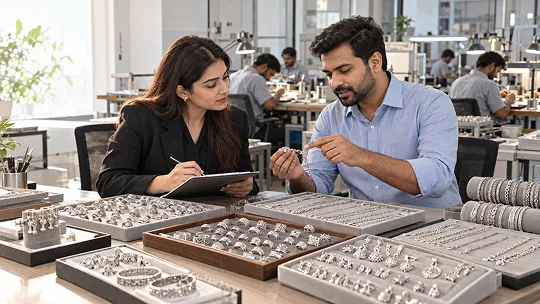
Choosing a jewellery manufacturer is not simply a matter of finding the lowest price. For wholesalers, retailers and silver jewellery businesses, the right manufacturing partner can influence everything from product consistency and inventory planning to margins and customer satisfaction.
A supplier may offer an attractive rate on the first order, but what happens when you need the same design again? Can the manufacturer maintain consistency? Is stock available when demand suddenly increases? Are product specifications and pricing clear before you place a bulk order?
These questions matter because wholesale jewellery purchasing is rarely a one-time transaction. A manufacturer needs to fit into the way a business buys, stocks, sells and grows. Here are seven practical factors wholesale buyers should evaluate before choosing a jewellery manufacturer.
1. Product Quality and Manufacturing Consistency
For a wholesale buyer, quality is not only about how a jewellery piece looks when it arrives. Consistency across batches is equally important.
If a retailer receives 50 pieces of the same design, customers expect those pieces to have a consistent appearance, finish, proportions and overall construction. Significant variation between batches can make inventory management and customer expectations more difficult.
Before selecting a manufacturer, buyers should consider:
- How consistently the manufacturer produces repeat designs
- Whether product specifications are clearly defined
- How finishing is maintained across larger quantities
- Whether the manufacturer has established production processes
- How product quality is checked before dispatch
- Whether the manufacturer can reproduce successful designs when required
This becomes particularly important when a retailer or wholesaler identifies a fast-moving product. Reordering should ideally result in products that remain consistent with the earlier batch.
For silver jewellery businesses, it is also useful to understand exactly what is being quoted. Weight, dimensions, silver specifications, finishing, quantity and other product characteristics can all affect the final price and buying decision.
Business takeaway: Don’t evaluate a manufacturer only from a single sample. Consider whether the manufacturer can maintain the same standard across regular and larger orders.
2. Manufacturing Capability and Production Setup
A manufacturer’s production capability can tell you a great deal about whether it is equipped to support your business over time.
There is a practical difference between a supplier that simply sources finished products and a manufacturer with greater control over production processes. Manufacturing capabilities can influence design development, production consistency, availability and the ability to handle repeat requirements.
One factor buyers may investigate is whether key processes are handled in-house. For example, in-house casting can provide a manufacturer with greater control over an important stage of jewellery production.
A buyer evaluating a silver jewellery manufacturer can ask:
- Which manufacturing processes are handled internally?
- What categories does the manufacturer regularly produce?
- Can the manufacturer support repeat orders?
- Does it have experience with wholesale requirements?
- How broad is its product range?
- Can it accommodate changing product requirements as the business grows?
Aditi Ornaments in Rajkot operates as a silver jewellery manufacturer and wholesaler, with in-house casting. The key is to look beyond a catalogue. A large product range is useful only when the manufacturer can maintain suitable consistency, availability and service across that range.
3. Product Range and Ability to Match Market Demand
A wholesale buyer rarely wants to depend on a manufacturer for only one type of product.
Retail businesses typically need a mix of products based on their customers, price points, seasons and changing demand. A broader product range can therefore make sourcing and inventory planning more convenient.
However, more products do not automatically mean a better supplier.
The important question is whether the manufacturer’s range is relevant to your market.
A retailer may prioritize everyday wearable pieces, while another business may focus on traditional silver jewellery, gifting products, children’s jewellery or seasonal collections. Wholesalers serving multiple retailers may require an even wider selection.
Before choosing a manufacturer, examine:
- Categories available
- Variety of designs within each category
- Different price and weight segments
- Regularly available products
- Seasonal products
- Ability to replenish popular designs
- Scope for expanding the range later
A useful approach is to divide products into three groups: fast-moving products, regular products and experimental products.
Fast-moving products deserve dependable replenishment. Regular products should maintain a balanced stock level, while experimental products can be purchased more cautiously until customer demand becomes clearer.
This approach helps prevent a common wholesale mistake: investing too heavily in a large number of slow-moving designs simply because they look attractive in a catalogue.
4. Pricing Transparency Matters More Than the Lowest Quote
The cheapest quotation is not necessarily the most economical purchase.
Silver jewellery pricing can depend on factors such as product weight, quantity, silver rates, manufacturing considerations, finishing and other applicable costs. For this reason, wholesale buyers should understand what is included in a quoted price before comparing suppliers.
Instead of asking only, “What is your price?”, buyers should ask:
- What specifications does this price cover?
- Is pricing based on actual product weight?
- Does the quantity affect the price?
- How are applicable silver rates considered?
- Are there additional charges?
- When is the final price confirmed?
- Does the price apply to repeat orders as well?
A clear pricing structure makes supplier comparison more meaningful.
For example, Manufacturer A may quote a lower unit price, but if its products have different specifications or additional charges arise later, the initial comparison may be misleading. Manufacturer B may appear more expensive initially but offer a clearer and more predictable overall cost.
For wholesalers and retailers, the real number to monitor is therefore not simply the purchase price. It is the landed cost and expected selling margin.
Clear pricing also makes it easier to calculate inventory budgets and decide how much stock can be purchased without putting unnecessary pressure on working capital.
5. Stock Availability and Lead Times
A product that sells well but cannot be replenished at the right time can become a business problem.
Inventory planning depends heavily on understanding how quickly a manufacturer can supply products. This is especially relevant during festivals, wedding seasons, gifting periods and other occasions when jewellery demand may increase.
Wholesale buyers should distinguish between:
Ready stock: Products that are already available for dispatch.
Made-to-order products: Products that require manufacturing after the order is placed.
Repeat production: Existing designs that may need to be produced again when stock runs low.
Each model has advantages, but the buyer needs to know which applies to the products being considered.
Ask about:
- Current stock availability
- Typical production timelines
- Reorder timelines
- Seasonal demand periods
- Availability of popular designs
- How stock information is communicated
Ready stock can be particularly useful when a wholesaler needs to replenish fast-moving products quickly. On the other hand, made-to-order production may be appropriate when a business needs specific quantities or designs.
The important point is to match the manufacturer’s supply model with your inventory strategy.
6. Order Quantities, Flexibility and Scalability
Minimum order quantity, commonly called MOQ, is an important consideration that is sometimes overlooked during supplier selection.
A manufacturer’s MOQ can influence how much capital a business must commit to inventory. For a large wholesaler, bulk purchasing may be straightforward. For a growing retailer or smaller jewellery business, committing to excessive quantities can increase the risk of unsold stock.
Before placing an order, understand:
- Minimum order requirements
- Quantity requirements by design
- Whether different categories can be combined
- Availability of smaller trial orders
- Reorder quantities
- How order requirements change for customized products
Flexibility becomes even more important as a business grows.
A new retailer may initially purchase a modest assortment to understand customer demand. Once certain designs begin moving quickly, the business may need larger and more frequent orders. A manufacturer that can support different stages of that growth can become more useful than one that is suitable only for very large purchases.
The objective is not necessarily to find a manufacturer with the lowest MOQ. It is to find an ordering structure that fits your cash flow, storage capacity, sales volume and growth stage.
7. Reliability, Communication and Long-Term Working Relationship
The final factor is often the easiest to underestimate: reliability.
Wholesale jewellery buying involves more than products and prices. Buyers need accurate information about availability, specifications, orders, dispatches and repeat requirements.
Good communication can reduce avoidable problems, particularly when orders contain multiple products or large quantities.
A buyer should consider whether a manufacturer:
- Responds clearly to product and order questions
- Provides accurate product information
- Communicates availability realistically
- Keeps order details clear
- Handles repeat requirements consistently
- Communicates delays when they occur
- Can support the buyer as order volumes increase
For B2B businesses, a reliable manufacturer can become part of the broader supply chain rather than simply another vendor.
This is one reason manufacturers with established industry experience may be worth evaluating carefully. Aditi Ornaments, has more than 35 years of experience in silver jewellery manufacturing and wholesale and serves B2B wholesalers across more than 20 Indian states. For buyers assessing potential suppliers, such operating history can be one useful factor alongside product range, manufacturing capability, pricing and stock practices.
However, longevity alone should never be treated as proof that a supplier is the right fit. Buyers should evaluate the complete picture against their own business requirements.
A Practical Manufacturer Evaluation Checklist
Before committing to a new supplier, wholesale buyers can use a simple checklist:
| Factor | Questions to Ask |
|---|---|
| Product quality | Is quality consistent across batches? |
| Manufacturing | Which processes are handled in-house? |
| Product range | Does the range match my customers’ demand? |
| Pricing | Are specifications and pricing clearly explained? |
| Stock | Which products are ready stock and which require production? |
| MOQ | Does the order quantity suit my working capital? |
| Reordering | Can popular products be replenished efficiently? |
| Communication | Is product and order information communicated clearly? |
| Scalability | Can the manufacturer support larger orders as my business grows? |
This checklist can also help buyers compare several manufacturers objectively instead of choosing one based on price alone.
Common Mistakes Wholesale Buyers Should Avoid
Even experienced buyers can make supplier-selection decisions too quickly. Some common mistakes include:
Choosing only on price
A low unit price can be attractive, but it does not tell you everything about specifications, consistency, availability or overall purchasing cost.
Testing too many products at once
A large initial purchase across dozens of untested designs can tie up working capital. A more controlled assortment can provide better insight into actual customer demand.
Ignoring replenishment
A product that sells quickly is valuable only if you can obtain additional stock when needed. Always consider the manufacturer’s reorder capability.
Not clarifying specifications
Before comparing quotations, make sure you are comparing products on a like-for-like basis.
Failing to assess communication
If basic product questions are difficult to answer before an order, managing larger orders may become more challenging later.
How Should a Wholesale Buyer Compare Two Manufacturers?
The best approach is to create a simple comparison based on the factors that matter most to your business.
For example, assign each manufacturer a rating for:
- Product consistency
- Relevant product range
- Manufacturing capability
- Pricing clarity
- Stock availability
- MOQ and ordering flexibility
- Communication and reliability
You can then give greater weight to the factors that directly affect your business.
A retailer with limited storage may give more importance to MOQ and ready stock. A large wholesaler may prioritize production capacity, range, consistency and replenishment. A new jewellery business may place greater emphasis on flexible ordering and manageable inventory investment.
There is no universal “best manufacturer.” The better question is:
Which manufacturer is the best fit for the way my business buys and sells jewellery?
Conclusion
Choosing a jewellery manufacturer is ultimately a business decision, not just a purchasing decision. The right supplier should fit the way your business manages inventory, responds to customer demand, controls costs and plans future growth.
For wholesalers and retailers, the most useful evaluation usually goes beyond the initial quotation. Product consistency, manufacturing capability, relevant variety, transparent pricing, stock availability, suitable order quantities and dependable communication all contribute to a stronger sourcing decision.
Before placing a large order, take the time to understand how a manufacturer actually works. A thoughtful supplier evaluation at the beginning can make purchasing, inventory planning and future reordering much easier.
Frequently Asked Questions (FAQ)
What should I check before choosing a silver jewellery manufacturer?
Check product quality, manufacturing capabilities, product range, pricing transparency, stock availability, MOQ, reorder timelines and communication. The right combination depends on your business size and inventory requirements.
Is the cheapest jewellery manufacturer always the best option?
No. Price should be considered alongside product specifications, consistency, stock availability, production timelines and overall purchasing costs. A slightly higher quoted price may make more business sense if the overall supply arrangement is more suitable.
Why is product consistency important for wholesalers?
Consistency helps wholesalers and retailers maintain predictable inventory. When repeat batches differ significantly, it can create difficulties with product presentation, customer expectations, pricing and reordering.
What is MOQ in wholesale jewellery?
MOQ stands for Minimum Order Quantity. It refers to the minimum quantity a manufacturer requires a buyer to order, either overall or for particular products, depending on the manufacturer’s ordering terms.
Why is ready stock useful for jewellery retailers?
Ready stock can help retailers replenish popular products without waiting for a complete manufacturing cycle. This can be particularly useful when demand increases unexpectedly or when fast-moving inventory needs to be replenished quickly.
Should a new jewellery business order a large quantity from a manufacturer?
Not necessarily. New businesses may benefit from starting with a carefully selected assortment and monitoring customer demand before committing significant working capital to inventory.
How can I compare wholesale jewellery manufacturers?
Compare manufacturers using consistent criteria such as product quality, relevant product range, manufacturing capability, pricing clarity, stock availability, MOQ, replenishment and communication. This provides a more useful comparison than looking at price alone.
Share


Latest Blogs
Oct 16, 2026
Why You Should Buy Complete Silver Jewellery Range from One Trusted Manufacturer
For a jewellery business, buying silver jewellery is rarely just about finding attractive designs. A...
Read MoreOct 16, 2026
Karva Chauth Silver Trends Every Wholesaler Should Know Before the Season
Karva Chauth has a strong traditional association with festive dressing, jewellery and rituals. While gold...
Read MoreOct 16, 2026
What Silver Jewellery Sells Best Around Dhanteras? A Buying Guide for Wholesalers & Retailers
Dhanteras can accelerate the growth of a jewellery business almost overnight. Products that move steadily...
Read More